Showing posts with label linux. Show all posts

Friday, May 7, 2010

NWR SAME software decoder?

Server weather season is upon us.

I have often thought it would be nice if there was an open source (soundcard/ FOB based) SAME decoder solution.

One could dedicate a cheap USB sound FOB to a receiver parked on their NOAA weather radio frequency that would sit and decode any SAME data bursts.

I am thinking for interfacing to repeaters to provide custom weather alert signaling.

It does appear that software to decode SAME data exists, just not open source.

http://www.dxsoft.com/en/products/seatty/

A SAME software decoder would benefit projects like thelinkbox, and asterisk app_rpt as well as other projects.

{Update 6/11}
Greg Hewgill, has updated the source to his NWR tools, now at:

https://github.com/ghewgill/nwr


"Drew" Kirkman, W4KMC writes:
"TECHNICAL INFORMATION:
NOAA’s Specific Area Message Encoding (or SAME) protocol is used to further streamline the Emergency Alert System. Information about an emergency message (such as locations affected, type of message, where it’s coming from, and how long it will be considered effective) is transmitted in the form of digital bursts at the beginning and end of said message. These bursts are AFSK-modulated data with a throughput of 520.83 bits per second. Mark tone (binary 1) is 2083.3 Hz and space tone (binary 0) is 1562.5 Hz, with each tone lasting about 1920 microseconds. Bytes are transmitted in reverse order (LSB -> MSB), that is, 00010111 would be transmitted as 11101000. There are other technical specifications regarding its use in the real world, but it’s irrelevant here. Essentially, if you handed the right text to it, I have a SAME encoder. It outputs true SAME-encoded data."

See his NOAA SAME web based audio encoder/decoder at:
http://www.drewkirhttp://www.blogger.com/img/blank.gifkman.com/projects/noaa-same/

I also stumbled into:

"Using an Arduino Uno and a few other external components, I've been able to reliably decode the SAME messages."

http://www.raydees.com/Weather_Radio.html


{Update 2012}
Someone updated multimon, and it now has EAS / SAME decoding support!
https://github.com/EliasOenal/multimonNG/blob/master/README

And this PHP-based SAME AFSK encoder: http://www.whence.com/minimodem/

Monday, February 1, 2010

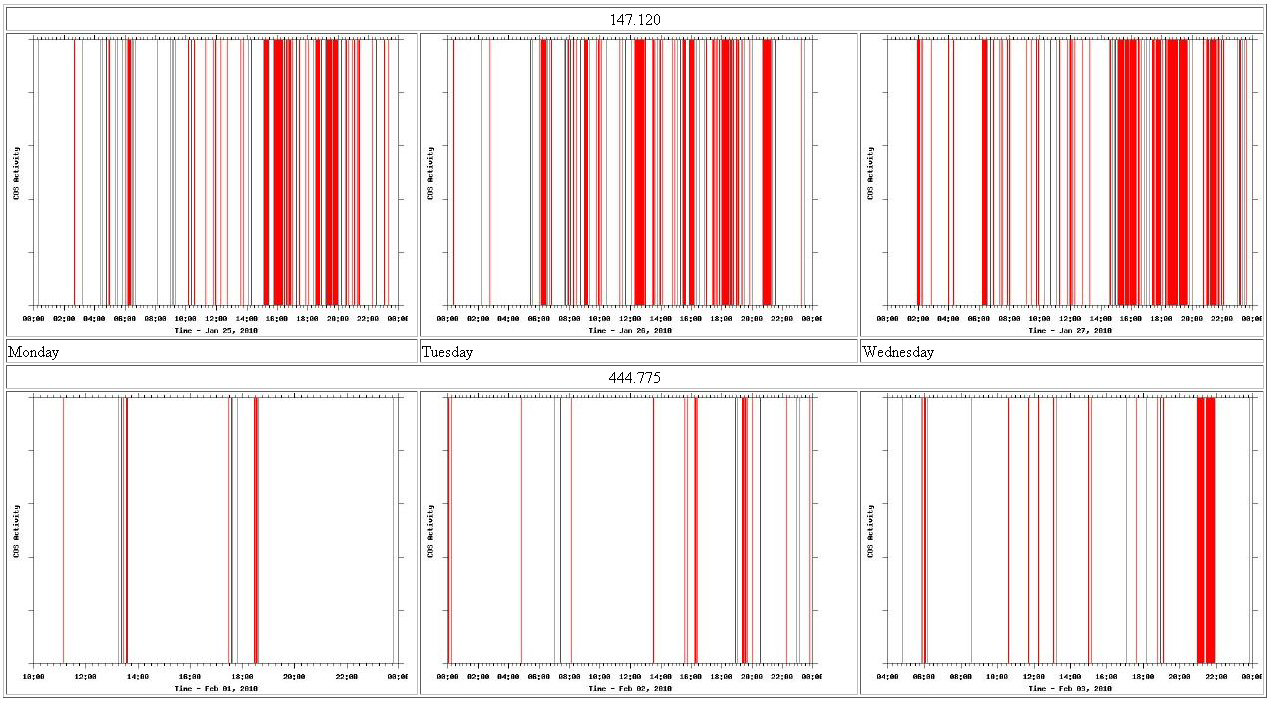
Vellman K8055 & Activity Graphs


I recently picked up a Vellman K8055 interface board.

My original application was in conjunction with Jonathan, G4KLX's D-Star project. He has since added other methods of support for transmitter control, such as legacy serial port keying.

The Vellman board has 5 digital input channels and 8 digital output channels. In addition, there are two analogue inputs and two analogue outputs with 8 bit resolution. As one can imagine, it has a lot of potential applications.

I had a guy interested in my repeater activity graph scripting that I mentioned a few years ago. That was designed around repeaters with IRLP as this would just be a simple add-on for the Linux machine.

So for my first Vellman idea, I whipped up some perl code to watch a COR of a radio and provide the same logging and graphing functionality.

Refer to the original documentation if this interests you. I have updated it.

http://www.qsl.net/kb9mwr/projects/voip/activity-graphs.html

Sunday, December 6, 2009

Amateur Radio and Linux


One of my favorite magazines Linux Journal, also has a few articles in their January 2010 magazine.

Back in April 2007 on the Texas A&M University Amateur Radio 802.11 Mailing List I made some comments that hams of the past were perhaps one of the earliest adopters of the open source way of doing things. This was spawned from some discussion with another local ham, who happens to be one of my elmers.

Leaders in the ham radio arena who are to busy beating their own chests touting things like they are the "national association for amateur radio."

These so called leaders need to suggest/ lay some general concepts to steer the hobby to the future, or perhaps they have a lack of approach. If I read one more thing about contesting or a home-made keyer, or restoring a boat anchor I'll probably puke. Instead put that in a specialty magazine, and focus on spreading the importance of the open source concepts in the ham radio arena in your monthly distributed membership magazine. Focus on promoting the "right ideas" in that precious well distributed rag. I don't see much of this steering, just a bunch of nostalgic crap. Ham radio needs to promote exciting things and new technology to entice people to the hobby or drag people out of the wood work. Retired people will find their way into the hobby on their own, to re-live the past.. In my opinion, we don't need to have oodles of crap for these people, they will come on their own and that's fine.

Ham radio needs to promote exciting things and new technology to entice people to the hobby or drag people out of the wood work. IRLP is a good recent example. It can take that "magic of HF", and make it portable, as in HT portable. This day in age, a big old HF rig, isn't cool, nor usually an option for most renters or apartment dwellers.

Packet in the 80's & early 90's was enticing, because it was at competing speeds to the internet that was in it's public infancy at that time. The autopatch in the 90's was enticing as cellphone were not yet main steam. Both of these examples happen to fall about the time of the no-code license became available. But many seem to attribute the in-rush of hams in the 90's due to the no-code license scheme revision. That went hand in hand with the these exciting technological things, it was not solely due to the new entry class. If there is nothing "cool," I'd bet you'd have a hard time giving a license away... and that does not insure they will use it! People actually bucked down and learned code, even if they hated it... ask yourself why. It's probably because there was an aspect of the hobby they perceived
as cool/interesting at the end of the rainbow.

New and interesting things in ham radio generally means encouraging experimentation. As experimentation is what brings new modes, and discoveries to the hobby. Not everyone will partake in that experimentation, but if there is a new discovery from those who do, everyone can later "play" with it, when it catches on. Open source, open information, encourages this experimentation

Hams or the past were perhaps one of the earliest adopters of the open source way of doing things.

We acknowledged this was done out of necessity - radio stuff was expensive and out of the reach of a lot of hams. So they invented newer and mostly cheaper ways of doing things. They also came up with better ways of doing things because somebody else would see that idea in print and improve upon it. Of course the technology was rather rudimentary, and there was little way to go but up at that point in radio technology calendar.

We also felt this is not so much the case anymore.

The current demographic of hams is skewed toward old. These people seem to be in either one of two camps. First is the retired person who has "made his fortune" (or at least is reasonably well off financially) and is not worried about inventing ways to do something on the cheap. They just buy an appliance and go from there.

The second group is middle aged and sees ham radio as not only a hobby, but a way to make some bucks. These are the guys that have an economic interest in closed source. They file part numbers off of chips, they cover circuitry in epoxy, and delude themselves into thinking that they will make a nice future retirement income from that "magic" CW keyer that they designed.

They don't do ham radio for the altruistic reasons (although some may have started out that way), it is money for them.

It seems to us that any change in the hobby needs to be political/philosophical. That means a change in leadership of the ARRL as they are the most prominent force in the hobby. This has got to be a grass-roots movement and it needs to start ASAP. The hobby will be gone and replaced by a "Citizen Communication Corps" if nothing is done.


In this Linux Journal issue one of the articles is titled along with some of the same thoughts. "When All Else Fails—Amateur Radio, the Original Open-Source Project"

What most people tend not to think about is the open-source nature of Amateur Radio. While operators most often are seen working in emergency situations, many of the modern conveniences we have today—cell phones, satellites, wireless devices— were developed and tested by radio amateurs.


On page 46 "An Amateur Radio Survival Guide for Linux Users - A getting-started guide for Linux users looking to venture into the world of Amateur Radio" by Dan Smith. This is an overview of common amateur radio activities with information on how to participate using a Linux system and free software.

On Page 50 you will find information on Xastir. An Open Source Client for the Automatic Packet Reporting System (APRS). Subtitled "Plotting Mars Rover locations on a detailed map, easily done with Linux? You Bet! By Curt Mills, Steve Stroh and Lara Mills.

Starting on page 56 of this issue, an article titled "Rolling Your Own With Digital Amateur Radio" by Gary Robinson. He points out that Amateur Radio and open source are a heavenly match.


Amateur Radio operators are generally free-thinking individualists who don’t mind getting their hands dirty to get something done right. Many of us do not think twice about buying a brand-new radio for hundreds or even thousands of dollars and popping the lid on it to see if we can modify it to make it better. You do not have to look hard to find myriad articles on how to modify different pieces of Amateur Radio equipment. So, it is not surprising that we might feel the same way about the software we use.

Open-source software and Amateur Radio are a natural fit. Few operators ever would buy a piece of radio gear if it came with a license that said they could not modify it, and it’s natural to see why a lot of us navigate toward open source in general and Linux in particular.


I encourage you to pick up this copy at the newsstand if you are not a subscriber

Thursday, January 1, 2009

A compatible IRLP Interface Schematic


IRLP nodes generally must use official IRLP boards. Their reasoning is that headaches the IRLP volunteers would have to deal due to nodes using self-built cards that weren't behaving properly. It appears impossible to obtain an IRLP node number without an order form and payment. http://www.irlp.net/orderform.html The IRLP board is $105. They also suggest a $40 donation.

However maybe you are interested in messing with a Linux based repeater controller. Or are I need of a spare IRLP board for interim node setups and testing.

Kyle, K0KN has designed a schematic for people in these situations, to emulate the IRLP board. This is perfect for people in these situations, as seen here. Otherwise you might find some people willing to part with theirs on the IRLP mailing list.

The IRLP board has an on-board hardware MT8870 DTMF decoder. It feeds the decoded digits as a four bit word to the printer port on the PC. This helps to ensure you have dull duplex control at all times, no matter what the state of /dev/dsp.. The decoded digits hit the custom_decode file where you can script/define functions.

If you wish to use IRLP with a different open interface such as the VA3TO, WB2REM, G3VFP, G4CDY,...Rigblasters, MFJ, SignalLink, etc. (as many of these interfaces have schematics readily available.) The following two open projects have the code necessary to talk to interface IRLP to other hardware interfaces. The rtpdir bridge - to bridge EchoLink IRLP and Asterisk . And thelinkbox also supporting USB sound FOB interfaces.

Monday, July 14, 2008

Two-Tone Pager Decoding Using Multimon


Here is a handy Linux based project that I recently worked on for a friend who happens to be a volunteer fire fighter.

A lot of rural volunteer fire departments still rely on the Motorola two-tone sequential paging system and analog Motorola Minitor pagers for dispatching their crews to a fire scene. The standard "Motorola Quick Call 2" paging protocol consists of playing two separate audio tones, the "A" and "B" tone. The "A" tone is played first for one second, then the "B" tone for three seconds. Both of these tones are transmitted on the fire dispatch frequency (VHF usually) which the pager is tuned to. Inside the older Minitor pagers, a mechanical reed is used to filter and decode each of the proper tones. While this may sound primitive, it is actually very reliable. A modern tweak to this type of paging system would be for the fire dispatch page to also be sent to your computer or cellular phone via text or email message. That is what this project will attempt to cover, with the pager tone decoding being done in software instead of having to tie up an additional pager.

For the tone decoding software, I used a slightly modified version of Thomas Sailer's multimon Linux radio transmission decoder.

{Update 2013}
Someone forked the original Multimon.  The original version was badly in need of updating for compatibility with modern Linux installs.  The fork is called multimonNG.


http://dekar.wc3edit.net/2012/05/24/multimonng/

In addition to showing how to modify the source code to match the tone sequences you want to monitor, there is a patch to enable a "quiet output" option to the DTMF decoding and also flushes stdout for better reliability when used in this application. A potential Perl script to trigger an external commands such as start recording or send a text message/email to ones phone is included.

You can read more about the specifics here.

Monday, May 28, 2007

Repeater Activity Graphs


In this piece of documentation, I show how to generate on the fly line graph image files of repeater activity.

http://www.qsl.net/kb9mwr/projects/voip/activity-graphs.html

In this case we assume the repeater has an IRLP computer running the Linux operating system already interfaced to it. The IRLP hardware interface an system binaries already provide us the necessary basic tools. We don't need a basic stamp or PIC interface.

IRLP has a readinput binary for troubleshooting. This reports; cos active, cos inactive, ptt active, ptt inactive, and all dtmf decoded. Since this is always connected to your repeater system you can use it as a data basis to generate a visual graph of system activity using gnuplot, a command line utility. This is handy to identify when the system is most active. You can have the graph export to a club website or just about anything you can think of. I have the file output use the day of week name in it, so you can easily look at weeks worth of data.