Saturday, October 20, 2007

Encryption and ham radio?

This is an area almost guaranteed to ruffle a few feathers. And that political stuff isn't the point of my blog. However it does apply directly to my "develop the data aspects of the hobby"... furthermore there seem to be a lot of misconceptions.

First off, the word "encryption" is not in Part 97 at all. What hams are thinking of is Section 97.1 13(a)(4) of the FCC rules, which prohibits "messages in codes or ciphers intended to obscure the meaning thereof, except as otherwise provided herein.. ."

The ARRL feels that encryption is ok as long as the purpose is NOT TO HIDE the message content is within Part 97. While the basic point is that our ham bands are not meant to be secure against casual listening. However, when we are providing communications for some agency or organization, such as for disaster relief, those agencies have some expectation of confidentiality. Information about people, as well as movement of supplies and resources, is not meant to be heard by the general public.

As one should see in this case, the encryption's purpose is not to "obscure" but to provide security for sensitive / confidential information from the general public, not even necessarily from other amateurs. A good long standing precedent example is where encryption has been used on amateur satellite control uplinks for many years.

In a data applications, this easily can apply to passwords and access control. Passwords or small snippets of data surely don't hide the message as they are not necessarily even the message itself.

To further this, an amendment made to Article 25.2A (1A) at the 2003 World radio Conference no longer specifically prohibits the use of encryption and other strong security measures on transmissions between Amateur Radio stations within the same jurisdiction. 

To summarize, the the purpose is what matters, or your intent. The rule is not regulating a method or practice; it regulates a purpose or intent.

If we are encrypting for network security and access control, emergency communications, and/or practice for the same—our purposes in using encryption are the security of the network and the privacy of third-party information. In either case, the purpose is not to obscure meaning.

Whatever encryption methods you use WEP, WPA, WPA2, or whatever—it must be publicly documented. (This is to conform with 97.309's authorized data emission code requirement.) Please note that this specifically means the encryption algorithm, not the encryption key.

Frank Rietta, KI4AWF writes a good piece titled; Authentication Without Encryption for Ham Radio.

The type of authentication process he illustrates has been used for a couple decades on packet radio nodes for remote access to the sysop / administration modes.

I feel few will have any qualms about this use of authentication in ham radio.

So ask yourself if this is okay, what about authenticating entire messages?

Again it has has to do with intent. Further exemplified by:

From the ARRL Message Handing Form:
ARRL FSD-3 contains Relief Emergency Recommended Procedures which allow for the use of “numbered” Radiograms. FCC rules and regulations allow for these ARRL numbered shortcuts as they are not intended to obscure the contents of the message, but rather to further reduce the possibility of ambiguity or error. These “numbers” refer to the following shortcuts in Group One for Possible Relief Emergency traffic – not to the “message number” box on the Radiogram.


For further reading see;
"Data Encryption is Legal," by N2IRZ, CQ Magazine Aug 2006 Or his other version printed in TAPR's PSR, Summer 2006, titled "Some Encryption is Legal"
"HSMM and Information Security," by K8OCL CQ-VHF Fall 2004

Thursday, August 16, 2007

What is ham radio?

1912 marked the beginning of the amateur radio service. It should be noted that there were many radio experimenters or radio amateurs before this time that lead to the discovery of radio. Even after 1912 many important discoveries where made in radio by radio amateurs.

The FCC's section 97.1 defined the basis and purpose of ham radio:

(a) Recognition and enhancement of the value of the amateur service to the public as a voluntary noncommercial communication service, particularly with respect to providing emergency communications.

(b) Continuation and extension of the amateur's proven ability to contribute to the advancement of the radio art.

(c) Encouragement and improvement of the amateur service through rules which provide for advancing skills in both the communications and technical phases of the art.

(d) Expansion of the existing reservoir within the amateur radio service of trained operators, technicians, and electronics experts.

(e) Continuation and extension of the amateur's unique ability to enhance international goodwill.

As you can see the emergency communications part that usually is the first thing to stand out in our minds is actually only a small part of what we are supposed to be. We exist and have access to a very valuable resource (the radio spectrum) because of or contributions, discoveries and experimentation.

Now lets look at that radio spectrum that we are so graciously given...

Amateur Allocations - Little known fact - Did you know in the US amateurs have access to approximately:
3.75 MHz of HF (160m-10m) spectrum
67 MHz of VHF/UHF (6m-33cm) spectrum
24.095 GHz of microwave (23cm-300GHz) spectrum

I hope you can see where our largest frequency allocations are. These are also unfortunately ham radios least actively used allocations. Yet, these higher frequency allocations are typically the ones most actively targeted by companies putting pressure on the FCC. There is little commercial interest in HF frequencies. Companies want to allow unlicensed operations over a wider frequency range (some moneymaking operations like PCS cell phones are actually Part 15 unlicensed transmitters). There is much more amateur spectrum to lose if we don’t use it more actively.

By the way; these truths are the point of my blog.

Wednesday, June 27, 2007

Amateur Paging


Back in the late 80s through the 90's, two-tone paging was pretty popular. Many repeater controllers were setup to send these. Hams caring around the popular Minitor pagers on their belts could be summoned via a touch-tone invoked setup on the repeater. You don't see much of that anymore for whatever reason. The only people you noticed still being voice paged are usually volunteer fire / EMS guys.

The idea of digital paging always interested me, but it never seem to have gotten much attention in the ham radio world. Perhaps now that digital voice formats are emerging it's time to touch briefly on the idea again.

Back in the 90's Clive Cooper, G8UNK wrote a software POCSAG digital paging encoder. Kantronic's also came out with the KPC-9612 TNC cable of encoding POCSAG. (If you are wondering what POCSAG is, it's a well known standard for radiopaging)

Paging is kind of a one way deal, much like those beaconing the APRS locations. If this sounds interesting, here is a link for more information:

http://www.qsl.net/kb9mwr/projects/pager/plan.html

Monday, May 28, 2007

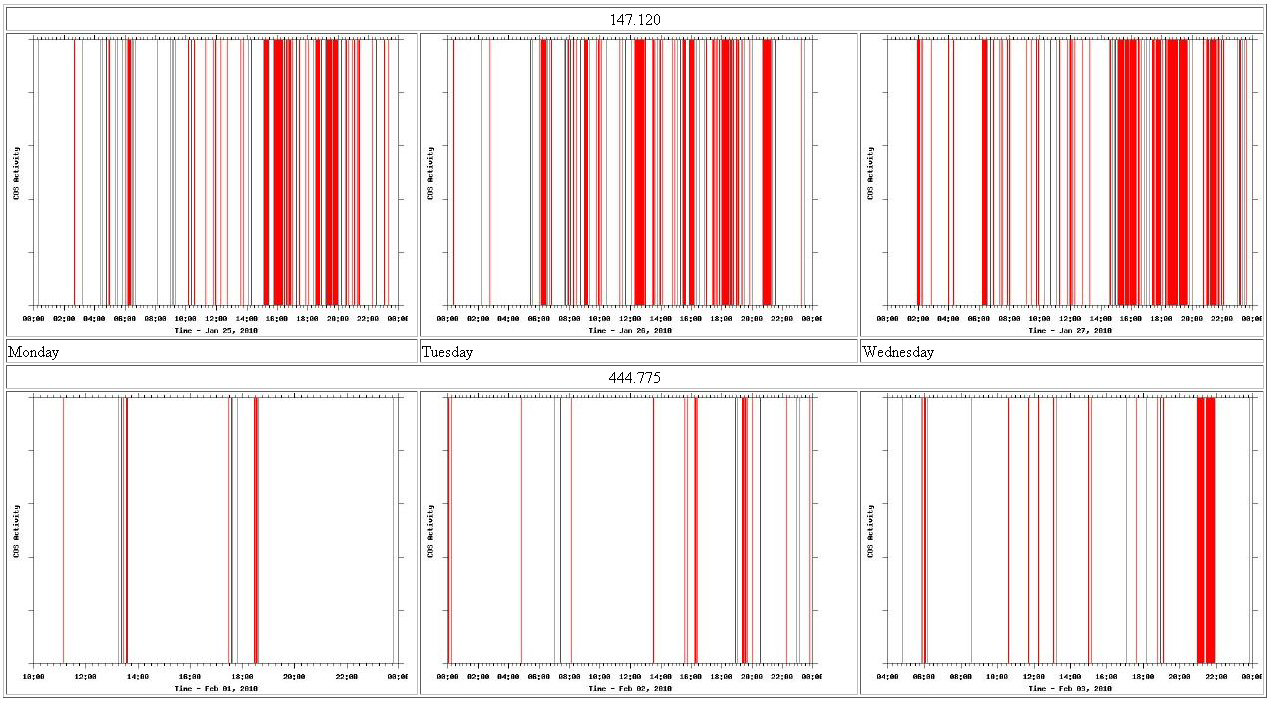
Repeater Activity Graphs


In this piece of documentation, I show how to generate on the fly line graph image files of repeater activity.

http://www.qsl.net/kb9mwr/projects/voip/activity-graphs.html

In this case we assume the repeater has an IRLP computer running the Linux operating system already interfaced to it. The IRLP hardware interface an system binaries already provide us the necessary basic tools. We don't need a basic stamp or PIC interface.

IRLP has a readinput binary for troubleshooting. This reports; cos active, cos inactive, ptt active, ptt inactive, and all dtmf decoded. Since this is always connected to your repeater system you can use it as a data basis to generate a visual graph of system activity using gnuplot, a command line utility. This is handy to identify when the system is most active. You can have the graph export to a club website or just about anything you can think of. I have the file output use the day of week name in it, so you can easily look at weeks worth of data.

Monday, May 14, 2007

Spread Spectrum


Spread spectrum is a radio technique that continuously alters its transmission pattern either by constantly changing carrier frequencies or by constantly changing the data pattern.

If you asking why, then let me point out that in order to support a high speed or multi-media transmissions you will need a bit of bandwidth. The 2 meter band is only 4 MHz wide, and already well populated. Spread spectrum can share the same frequency band (overlay) with other uses.

Spread Spectrum was invented in 1940. Austrian-born Hedy Lamarr, considered one of the sexiest actresses of her time, was also a co-inventor of frequency hopping.

There are two basic types; Direct Sequence Spread Spectrum (DSSS) and Frequency Hopping Spread Spectrum (FHSS).

DSSS is the basis for CDMA cellphones and 802.11 wireless transmission. FHSS is used for bluetooth devices.

It wasn't till 1981 that the FCC authorized spread spectrum on amateur frequencies. In late 1999 the FCC relaxed Amateur Spread Spectrum rules. (Prior only certain spreading codes where allowed)

Presently Part 97.311 of the rules effectively limits amateur spread spectrum to 1 watt. Please support the passage of RM-11325, to have that 1 watt limit lifted. Spread spectrum this day in age, should not be treated as an inferior mode.

It may seem like a moot point to some. For you see 802.11b is direct sequence spread spectrum (DSSS), but it has largely be replaced by 802.11g and 802.11a, both of which use Orthogonal frequency-division multiplexing (OFDM) modulation instead of DSSS. OFDM is technically not spread spectrum and thusly is not encumbered by the 1 watt rule.

Frequency hopping spread spectrum (FHSS) is in my mind the best fit for the present ham band plans. In FHSS the carriers are narrow and "hop" around only staying on a given frequency for less than a second. It's also hops around interference.

DSSS on the other hand is spread over a wide fixed spread of frequencies, usually occupying several megahertz. 900 MHz and above the bands are pretty un occupied so fitting DSSS in isn't really and issue. But as you should see FHSS stands the best chance of working in amateur radio on band 70 centimeters and below, on bands where there is already occupancy.

Data networking aside, there are now some new FHSS voice radios out there for 900 MHz. They are both obviously digital voice and capable of text messaging.

Motorola DTR650
Apparently Motorola has repackaged their off network iDen 900 MHz ISM FHSS walkie talkie feature into a simplex radio. Range is actually 1/2 way decent on them from what I've seen, couple miles line of sight. It has a removable antenna. The price is around $300


TriSquare eXRS Radios
906 to 923.75 MHz, 50 hopping channels, 1 watt power, -124 dBm receive sensitivity, 397 ms. dwell time, 11.5 KHz occupied bandwidth. Integrated antenna, but can be modified with an SMA connector. Nothing to compare with the Motorola DTR radios. Nowhere near the price either. These can be picked up at higher end sporting good stores usually for under $100 a pair.

Brian NB9E writes about the Trisquare radios:

While doing some mountain top maintenance on some of our ham repeaters here in northeastern NV (Elko area) I made contact with my wife (kc1ndy) around 30 miles from Swails Mt in Carlin to Pleasant Valley(near Lamoille). One radio was modified with an SMA connector and an SMA-3 Comet rubber duck which is rated for 2m,440 and 915!!! Impressive range to say the least for 1 watt!!! As far as legalities go the unit operates in the ham band limits and can be re-certified under Part 97 rules. The unit boasts over 1 billion channels actually hopping sequences. It really only hops 50 channels between 906 and 923 about 396 Ms each if I remember correctly. A better choice though might be the Moto DTR-650 which has a removable antenna!!! I've yet to get my hands on a pair of these yet, but they're on my list!!!


For more information see the March 2008 Popular Communications Magazine Tech Showcase article on the TSX300 by Bernard Bates

The TriSquare units use use analog FM instead of digital modulation for the voice, while the Motorola DTR's use digital modulation. There have been reports that an Optoelectronics R-10 can lock right onto the TriSquare FHSS signal and hearthe audio with no problems whatsoever.

Sunday, April 22, 2007

HSMM with the 900 MHz Aerocomm modem


High Speed Multi Media (HSMM) is often referred to as being the Hinternet (Ham Internet), as it is primarily used under FCC Rules & Regulations Part 97. Under Part 97 commercial off-the-shelf equipment can be used at higher power and higher gain than the more common Part 15 802.11a/b/g operations.

The primary purpose for HSMM and Hinternet is to augment emergency communications via long range high speed wireless data networks that can handle voice, data and video communications. HSMM can also be used in the day-to-day aspects of Amateur Radio Communications.


The AeroComm CL4490, is a 1 watt 900 MHz, frequency hopping spread spectrum (FHSS) serial modem that can yield 20-25 kbps of throughput. They are about $100, which is really quite reasonable considering the price of a conventional TNC and radio.

The actual RF module itself (AC4490) can be bought for $62. The complete AeroComm CL4490 transceiver includes the AC4490 module housed in a nice aluminum case with an internal switching power supply and the necessary RS-232 to TTL conversion circuit.

We have experienced solid mobile non line of site coverage for 3 miles, with mobile coverage extending to 6 miles depending on terrain. This is with a measly 6 dB base station at 35 feet. Distances over 20 miles line of site are theoretically possible with these.

For more information on the Aerocomm, and to obtain specifics on the network configuration see:
http://www.qsl.net/n9zia/aerocomm/

HSMM Information Resources:
http://en.wikipedia.org/wiki/Hinternet
http://www.qsl.net/kb9mwr/projects/wireless/plan.html

Wednesday, March 28, 2007

A Universal Programming Interface


This Russian website has a schematic to build a radio interface box (RIB) that can program, Kenwood, Motorola, Icom, Yeasu and other radios. It's capable of programming portable and mobiles and well over 500 different models.

So stop throwing your money away on all the various programmers out there, and build this one.

Sunday, March 18, 2007

Advanced Receiver Preamp Modification


I have used both 2 meter and 440MHZ GaAsFET versions. If you read the comments on eham, you'll likely be confused as to whether it is a good product. I can assure you they are. The reason the older bipolar ones don't seem to have a back eye is simple, they are less sensitive.

However I've found that if you add a pair of back to back silicon diodes (1N914) to the GaAsFET preamp's input this will protect it from overloading. That's almost an essential mod on these GASFET preamps as they are very static sensitive. Even more so for a repeater site where strong field strengths (or lightening prone areas) are present. However, at repeater sites, ideally your preamp should have a preselector.

You add a pair of back to back 1N914 diodes to the preamp's input to protect it from overloading. As you can see the two I drew-in are in parallel, in back to back, opposing directions (anode to cathode). The pair is soldered onto the center feed antenna input to ground. The idea is to always clamp the input signal to always a safe level and protect the preamp's FET from overload.

Thursday, February 15, 2007

1.2 GHz HSMM with the Icom ID-1


Back in June 2004 we inquired about Icom's 1.2 GHz ID-1 D-Star solution for ham radio voice and data communications. We were fortunate enough to be able to evaluate it for a few months.

Our short documentation is located at:

http://www.qsl.net/n9zia/dstar-evaluation/

You can also read the Wisconsin Amateur Packet Radio review here:
http://www.qsl.net/kb9mwr/wapr/0204.html

We were most interested in the data performance and networking ability of the D-STAR system. The only radio that can do any significant data transfer is the 1.2 GHz ID-1. It's listed with a (theoretical value) transmission speed of 128 kbs. We clocked an effective TCP/IP throughput of 90 Kbs. Perfectly understandable considering protocol overheads.

We didn't have a lot of time to mess with it. Our initial path was a 4 mile hop, but that was just on the fringe due to the Packers stadium in the middle. We could communicate using the digital voice mode and analog FM, but not the digital data. A few more feet of height might have done it. We were at 60 feet at the remote end, and 40 at the other.

So we opted to test the data performance on a much shorter path with another local.

The lesson learned is even at 10 watts on 1.2 GHz, verses the 1 watt or less on 900 MHz or 2.4 GHz, microwave path loss doesn't change much.

So in our case for much, much less money we can accomplish the same paths at even higher speeds using other hardware. What would be interesting is to see how well the ID-1 would work mobile. I do believe it would work quite well for this compared to the alternatives.
{edit} Reports indicate that it takes a very solid signal into the Access Point/DD system to work well. And works good over a large area when non-moving, but motion/multipath tears it up. A continuous ping by with a 1.2 GHz radio would start working at very stop light, and stop as soon as was moving.


After having looked at the various documentation, the Digital Data (DD) mode of the 1.2 GHz Icom ID-1 is a rather strange design.

There is reason for concern on that the amount of overhead is huge (D-STAR header + Ethernet header + IP header), and that the FEC as implemented is a bit strange (why does it only apply to the D-STAR header, and not the Ethernet frame?). Further the protocol has no real mention of channel access concerns (collision detection, avoidance, etc). It really looks to me like DV with ethernet frames stuffed into the payload section (i.e. maybe it was somewhat of an afterthought).

All the DD mode appears to do is forward ethernet frames around. On its own, it does not do any acknowledgment/handshaking. This is all left to the upper-layer protocols (i.e. TCP).

It appears that if a collision happens then the DD packet is just lost, and there's no really mechanism to avoid collisions at the DD layer, either. It's up to the higher-layer protocol to do anything about it.

So you really have no indicator of channel quality when using it. The lack of this sort of thing seems like a major oversight. It looks like packet radio done badly, although with better speeds. If it were introduced 15 to 20 years ago we would have hailed it as the savior of packet radio, but now it looks like a poor imitation of WiFi.

To further, it doesn't help most of what you will read on the other D-Star Yahoo groups shows that the ID-1 isn't being used with good RF engineering practice leading to poor results.