Chris Paget, KJ6GCG has over a decade of experience as an information security consultant and technical trainer for a wide range of financial, online, and software companies. Chris' work is increasingly hardware-focused, recently covering technologies such as GSM and RFID at venues such as Defcon and Shmoocon.
At the recent Defcon 18 conference he displayed a spoofed GSM cellphone tower using a Universal Software Radio Peripheral (USRP) transmitting 25 milliwatts, to present a GSM air interface to a standard GSM handset and uses the Asterisk software PBX to connect calls. The combination of the ubiquitous GSM air interface with VoIP backhaul could form the basis of a new type of cellular network that could be deployed and operated at substantially lower cost than existing technologies in the developing world.
http://openbts.sourceforge.net/
FCC rules aside, this is some powerful stuff. Imagine being able to restore cellular coverage in a disaster area using the foundation he has laid.
You can read more here:
http://www.networkworld.com/news/2010/083010-open-source-voip-cell-phones-at-burning-man.html
Here is a video that shows a test call being placed from a softphone talking to an Asterisk PBX in conjunction with GNU radio and a USRP to create a Part 15 signal level call to a cellphone.
Regarding using HSMM style techniques for running an amateur cell site:
http://www.innismir.net/article/513
Here is a similar project which modifies android phone to use asterisk running on something called a mesh potato. This would be great for developing areas. Just drop some of the MP's with a battery and a solar cell and poof... a phone system.
http://www.villagetelco.org/
Another favorite is using asterisk with amateur radio and repeaters
http://ohnosec.org/drupal/
Showing posts with label ares. Show all posts
Showing posts with label ares. Show all posts
Wednesday, September 1, 2010

Tuesday, August 3, 2010
HSMM Mesh Network in Texas

In Collin County Texas a groups of hams have been making good use of HSMM technologies to update their Amateur Radio Communications Health-care Emergency Services (ARCHES). This was traditionally setup of two meter/ 70cm voice and packet radios at 9 Austin, Texas area hospitals.
The setup provides key patient data to the City of Austin Emergency Operations Center, during significant incidents, even if normal communications are unavailable. It's highly successful. During every activation, patient data and other traffic passed more quickly and accurately than all other techniques tested during the activations.
The ARCHES program has been so successful, we have been asked to expand the system to ~ 40 additional area hospitals and clinics in central Texas.
Due to the existing significant number of packet collisions using traditional packet radio with just 9 nodes, they are migrating to HSMM.
With 40 or more packet stations in the area, passing packet data could slow to a crawl due to packet collisions.
The stations could only transfer data at 1200 baud, at best. Attempts at using 9600 baud showed that common radios do not pass 9600 baud data well. They distort the data so badly, that many resends are needed to get data through.The effective data rate seldom exceeds 1200 baud.
The HSMM proof of concept was demonstrated least year by AD5OO, NG5V, and KD5MFW who achieved a 10 mile point to point link across downtown Austin, Texas using only 35mw.
The Austin HSMM SIG has incorporated Optimum Link State Routing (OLSR) into custom firmware to provide automatic linking of radios that will be placed on Water Towers throughout Collin County Texas.
For more info see: http://hsmm-mesh.org
Monday, July 5, 2010
Keeping relevant & moving forward - case in point

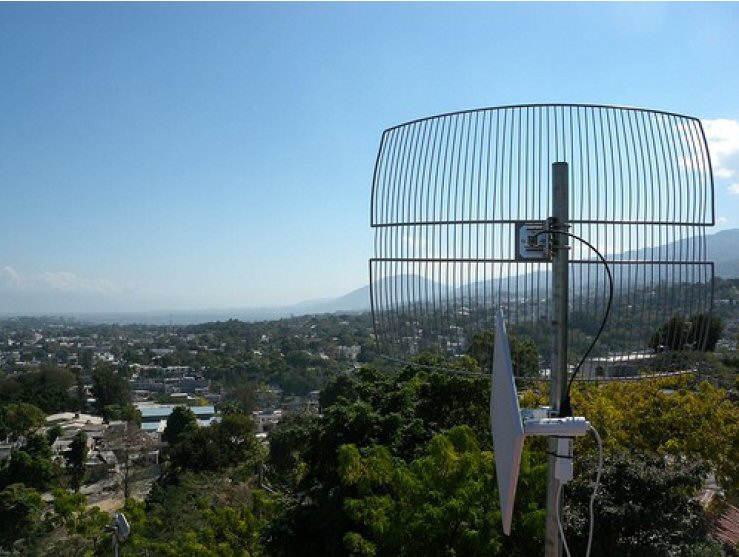
The following is a partial excerpt from a presentation by Glenn Currie, KD5MFW at Ham-Com 2010 held June 11-12 in Texas. (You can read the full presentation and others at: http://www.hsmm-mesh.org/)
Those deploying communications technology in developing countries are deploying systems in areas where there is little or no infrastructure... much the same as after a natural disaster.
They are using wireless mesh systems for much of their infrastructure. When you have no infrastructure due to disaster, natural or otherwise, Wireless mesh networks are being deployed.
An organization called Inveneo works to bring communications infrastructure to under developed countries.
They use Wi-Fi (802.11) wireless broadband equipment for much of their work. They set up Wi-Fi communications links and add their own resources including small web servers and end user net top computers so people can send email and check websites for emergency information.
Inveneo deploys to Haiti after the recent earthquake. The got in fast with gear and two man teams.
Inveneo installed a Wide Area Network using Wi-Fi type equipment. Inveneo quickly deployed an emergency network that served many agencies
Amateur radio passed some traffic in the aftermath of the recent Haiti earthquake. I have read the reports on the Internet and in the printed amateur radio magazines. Hats off to all the hams that pitched in and helped strangers in a bad situation.
But what systems past what percentage of the emergency traffic during the emergency? What really worked and carried the bulk of the emergency traffic?
It is known that the network deployed by Inveneo passed Thousands of Messages for multiple agencies, and their networks continue to pass traffic.
Amateur radio needs to have a broadband offering in their tool box.
All emergency communications organizations are making wide use of broadband RF communications techniques – except amateur radio.
I am confident, that if amateur radio manages to remain relevant, in the area of Emergency communications, future amateur radio license exams will include questions On how to configure wireless routers. This technology is that pervasive in the world. Hams can step up to the plate get into broadband, or they can leave it to groups like Inveneo and Part-15.org to provide emergency communications, in the ham bands.
I recently tried to point out that WinLink is showing its age and is far from ideal.
I was trying to suggest that we focus our efforts on the future, and made reference to a geostationary satellite as one avenue.
I received a bothersome/bullheaded comment from Stan Piekarczyk, Outagamie Co ARES EC "Should we wait another 10 years for this to get launched?"
To answer the question, NO!
The first step is admitting that something isn't cutting it, or is less than desirable. Step two is making it happen by stop being an amateur radio user, and becoming an innovator.
Ham radio technologies can Only advance if We make the happen. Glenn, KD5MFW points out some wake up calls for hams in his presentation. It's time to think ahead.
KC4BQK also blogged on this:
http://kc4bqk.blogspot.com/2010/07/january-2010-haiti-had-devastating.html
Sunday, January 3, 2010
EmComm & AMSAT's Geostationary Satellite

A very interesting overview of AMSAT's phase IV Geostationary Satellite and the possible emergency communications implementations is in the Fall issue of CQ-VHF.
As you can tell I don't have a lot of love for Emcomm, but here is something that actually makes sense. A high speed multi-media capable, geostationary satellite.
AMSAT has recently begun negotiating with INTELSAT to get amateur radio communication payloads “piggybacked” on commercial geosynchronous communications satellites. This would be a first for amateur radio. It would allow earth stations to have 24/7/365 communications over a very large area using small fixed antennas. A small dish antenna would be able to access voice communications and text messaging. A larger dish antenna could provide access to video and high speed data. Because this has obvious value for emergency communications, AMSAT hopes to get considerable funding for this project from emergency communications agencies.
Hams are well acquainted with radio coverage problems while providing emergency communications. The high frequency bands suffer from hourly to daily propagation challenges. VHF and UHF simplex channels have limited geographic coverage. A repeater improves coverage while restricting all operations to its fixed channel pairs. Most of our current operating modes offer voice communications only. If data is transmitted it is supported at low rates such as 300, 1200, or 9600 baud.
I hope this gets some backing from the ARRL ARES directors. I honestly don't understand why and how all these recommendations come down the EC line to promote stuff like WinLink. They should all get behind something like this that makes sense, and help promote development and deployment of terrestrial HSMM networks.
Monday, May 4, 2009
WeComm Digital Audio Repeater Linking

Wisconsin Emergency Communications (WeComm) is developing a statewide repeater system / voice network to provide base coverage throughout Wisconsin. Another imitative is to implement a modern high speed digital network. Both are for state, district and local ARES/RACES, skywarn, public service, and normal amateur radio communications.
The wide area analog repeaters are interlinked using SIP analog radio adapters. The Asterisk based conferencing software is virtually limitless. It provides the flexibility to connect individual repeaters into a statewide configuration, or to disconnect them to serve smaller areas or districts meeting specific needs.
This is a private VOIP network / reflector, unlike; IRLP and EchoLink. (Although the capability to link to such networks is still possible). Using IRLP, EchoLink or some other Wide Area Network linking services doesn't allow the control and flexibility that creating ones own off-network conferencing bridge. The aforementioned systems have a limited number of reflectors available and you are bound to their rules. Once the modern high speed digital network gets in gear the VOIP audio can actually be carried over these links instead of the internet.
SIP / digital audio repeater linking allows you to route / (think digipeat) . This is a great way to connect repeaters together that have quite a distance between them (or poor radio path).
SIP radio linking is also compatible with telephone circuits, and 21st century digital radio systems such as APCO-25, and D-Star. Such high speed multi-media interconnecting backbones can support radio linking of today as well as of the future.
Sunday, February 15, 2009
Flexibility of a HSMM network

KE7FTE, N7QQU and W9ERT show us the "drag and drop" flexibility of a HSMM platform. Offering reliable exchange of large image files, email, word-processing and other files that emergency responders and served agencies find invaluable.
The video does show what HSMM networks can provide for ARES. It should be clarified that this drag and drop flexibility is not exclusive to D-Star. It's a network file sharing protocol being employed between the laptops being used. Any TCP/IP based network can support this.
Yessj What's the range on this thing? It looks quite similar to a wireless peer to peer lan!
W7NWH
One big difference HAMS can use greater power with a upside of distance and robustness. Hams can use up to 1500 watts of power. Where your local wireless network is measured in millawatts to watts. With high gain antennas and lots of power ranges can exceed 50-80 miles. And that's peer to peer! Try that with your wireless LAN! Idea is this can provide emergency backbone for a LAN that is down in an emergency. Not super fast, just robust and proven!
Above are some of the youtube video comments. W7NWH is trying to make this pricey D-Star sound like it's fundamentally superior to common wifi. Yes hams can run more power, but that likely won't accomplish much more. Microwave propagation is microwave propagation. Height is the key item. If you don't have it, the 10 watt D-Star radios at 1.2 GHz won't yield much better paths than the under 1 watt paths that you could do with wifi. I don't know of any 1.2 GHz amplifiers to run more than the stock Icom ID-1 let you anyway. They have been several well publicized examples of 20-30 mile 802.11 links, and one 72 mile path!... One with a ham twist was published in the July 2005 QST, titled, "IEEE 802.11 Experiments In Virginias Shenandoah Valley."
One thing I've noticed is that command posts love telephones and fax machines. Pictured above you see an $30 analog telephone adapter. Talk about seamless to the emergency manager!
Another interesting and smart idea when it comes to repeater linking is to use analog radio adapters and link the repeaters over your HSMM backbone. Most repeaters are on decent tower sites already so linking such sites over microwave HSMM links should be very feasible. Now your linking channel is not just capable of voice, but can act as a high-speed back bone.
IRLP and Echolink linking are pretty prominent and well understood. In many cases there may be multiple repeaters in the same geographic area all linked (maybe even semi-permanently) using such common VOIP networks.
With HSMM backbones you can off-network link these. This is very emcomm friendly in the even a backhoe takes out internet to most of an area.
Thursday, February 5, 2009
Minneapolis Wi-Fi network aids rescuers - bridge collapse
So the real question is when are ARES/RACES groups going to realize its time to implement this using products like the Ubiquiti NS3/XR3 on 3 GHz, the lower half (2.3 GHz) of the 2.4 GHz ham band, the 5.8 GHz band, or even 900 MHz with something like the XR9.
Ubiquiti's AirOS firmware as well as popular third party firmware such as DD-WRT all now have mesh networking protocols like WDS (Wireless Distribution System) built in.
Mesh protocols are designed for self-healing networks that are able to load balance WAN (wide area network) access. They also combine some of the ideas contained in the Radio Shortest Path First protocol. If the you are not up to par on the dynamics of mesh networks, here are a few links:
http://en.wikipedia.org/wiki/Wireless_Distribution_System
http://en.wikipedia.org/wiki/Wireless_mesh_network
http://www.olsr.org/ An ad hoc wireless mesh routing daemon
You may also wish to read the article by John, K8OCL, titled "New High-Speed Multi-Media Radio Mesh Networking," printed in the Fall 2008 CQ-VHF magazine.
Mesh is very powerful stuff. And when you throw SIP / Asterisk based telephony on top of it, you have an instant voice system. Just plug in an IP phone or analog telephone adapter. Now not only can you exchange large image files, email, word-processing and other files that emergency responders and served agencies find invaluable. You can also pick up a phone or (seamlessly) bridge existing ones that are dead due to a land-line failure... etc.
From: http://www.arrl.org/tis/info/HTML/high-speed-digital/emergency-communications.html
Emergency communications offer the greatest opportunity for Radio Local Area Network (RLAN) technology to excel and for amateurs to push the envelope in the public service sector, using this technology....
Another good read is the Winter 2005 issue of CQ-VHF. John, K8OCL wrote a HSMM column on a HSMM portable setup for EmComm organizations.
Subscribe to:
Posts (Atom)